Deed of Release of Debt
Our Deed of Release of a Debt template:
- Solicitor-Drafted for 100% legal validity under English Law.
- Comprehensive: Releases individuals or companies from any loan or debt.
- Instant Download: Editable Microsoft Word format.
- Step-by-Step Guide: Includes full instructions for editing and signing.
- Money-Back Guarantee: Risk-free purchase for your peace of mind.
How Does It Work?
-
1. Download
-
2. Edit
-
3. Print
-
4. Sign

You can ensure a debt is gone for good. This Deed of Release of Debt template acts formally to extinguish a financial liability and provides the debtor (the person that owes the debt) with a permanent release and the creditor (the lender) with a clean break – even if the creditor is releasing the debt for free.
When to Use This Deed of Release of Debt Template
You can use our template deed of release in a variety of circumstances. The most common include:
- You are forgiving a loan to a family member, friend or close acquaintance.
- You are a company releasing a business creditor, or any third party, from a debt.
- The debtor has partially repaid the debt, but you have agreed to forego the balance of the debt.
Note that the deed of release will not be suitable in the following circumstances:
- You are releasing security that applies to a previously-settled debt.
- You are delaying repayment of the debt.
Where security has been taken to secure a debt, for example, a personal guarantee, as well as releasing the debt, you will need a separate document, such as our Deed of Release of Security.
If, instead of releasing the debt, you are selling it on to someone else to collect, then try these templates:
- Deed of Assignment of a Judgment Debt;
- Deed of Assignment of Debt; and
- Notice of Assignment of Debt.
What Have We Included in the Deed of Release of Debt Template Pack?
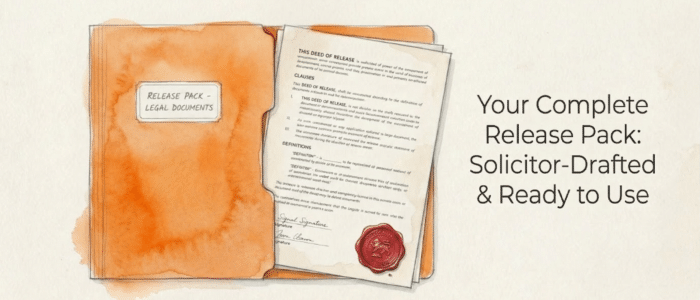
Once you have bought it, you can download our template pack, which also appears in your account for permanent future access. The pack includes:
- The Deed Template: A fully editable Microsoft Word document template.
- Step by Step Guidance Note: Easy to follow instructions written by Stephen take you through completing the template.
- Execution Guide: A guidance note with specific instructions for signing and witnessing.
- Pre-Use Checklist: Our 7-point final verification list to run through before you sign.
How to Use This Deed of Release of Debt Template

Once you have downloaded your template pack, follow the simple steps below to put the ‘release’ in place and benefit from a water tight legal agreement.
Step 1: Clearly identify the Original Debt
Open the Word document and locate the “Background” section, towards the top of the template. Here, you need to describe exactly what debt you are cancelling.
Example: “A loan of £5,750 provided by the Creditor to the Debtor under a loan agreement dated 12th May 2025” or “Unpaid invoices numbered 101 and 102 totalling £36,000”.
Step 2: Customise the Parties
Our template includes interchangeable sections to enable you to customise the deed depending on whether the creditor or debtor is a company or an individual. If the debtor is a company, it is preferable to use the registered address, which can be different from its trading address. You can look this up on the Companies House website if needed.
Step 3: Executing the Deed
Because the document is in the form of a ‘deed’ (I’ll cover below the difference between a deed and a standard contract), the parties must each sign it in the presence of a witness. You can print the completed document for ‘wet ink’ signature. Alternatively, the parties can sign it electronically, using a platform like Adobe Sign or DocuSign.
Even if signing digitally, under English law, it is a requirement that the witness is in the same room and ‘physically present’ when observing the signatory clicking the button to sign the deed.
Step 4: Dating and Delivery
It is critical that you do not date the deed until the last person has signed it. Once the last party has signed it and dated the document, the deed is valid and legally binding. From that point, you have legally extinguished the debt and it no longer exists.
Note that once you have given a ‘release’, you cannot undo it. You have irreversibly extinguished the debt.
Why a Deed and Not a ‘Contract’
In English law, most agreements are in the form of a standard ‘contract’. A key requirement of a contract to be legally binding is that there must be ‘consideration‘. This means that both parties must give something of value – like money in exchange for goods or services.
When you are releasing a debt, the debtor does not generally provide anything that the law would recognise as representing tangible value. If a debt release was in the form of a standard contract, it would not be enforceable. Unfortunately, we do sometimes observe this when people use poorly drafted letters releasing a debt.
By using a document in the form of a deed (which requires that (a) you called it a deed’ and (b) you have the signatures witnessed by an independent witness, there is no requirement for consideration. This makes it ideal as the type of legal agreement to use when releasing a debt or cancelling a loan.
Examples of When This Deed of Release of Debt Template Might be Used
The reality is that you most likely already know that this deed of release if a debt is the right document to use in your situation. But for those looking for further guidance and reassurance, I’ll set out below several common scenarios in which you would use a deed of release to waive a debt:
- Settling Disputes: when a party agrees to accept a smaller ‘lump sum’ in settlement of a debt a deed of release is required to formally waive the balance. Without one the debt legally remains due and could be called on even after purportedly waived.
- Waiving a director’s loan account: A director of a startup may choose to waive a loan that they previously made to their company. This is commonly done to improve the balance sheet when seeking to bring on investors.
- Family Wealth Planning: Where a family loan has been made and it has been waived, formally documenting its release makes sure that it isn’t counted as an asset owed to the estate for inheritance tax purposes. NB the release of the debt might count as a potentially exempt transfer for 7 years.
- Clearing Inter-Company Balances: Companies that are part of the same group of companies may lend money within the group. If one company is to waive the debt, then you need to waive it formally by deed. Otherwise, it will legally continue to exist.
Meet the Author: Legal Expertise You Can Trust
Stephen Avila – Solicitor and Legalo Co-founder
That’s right, this UK deed of Release template was written by me, Stephen. I am a practising solicitor with, at the date of writing, twenty-two years of experience in commercial and corporate law.
Here at Legalo, you get peace of mind in knowing that a solicitor has actually carefully drafted the document you purchase. Me and my co-founder David, who is also a practising solicitor, run Legalo – in his case, he has 30 years of legal experience. David looks after our customer support. If you need guidance or have any questions, please do call or message us. David will be happy to assist.
Frequently Asked Questions (FAQs) about the Deed of Release of Debt Template
Q: Is a deed of Release the same as a “Deed of Waiver”?
Yes, a Deed of Waiver refers to the same legal document, and is a term people often use to refer to a deed of release of a debt.
Q: Which is better, a Deed of Gift or a Deed of Release?
It is better to use a Deed of Release when you are ‘writing off’ money that due to you. Whilst you could, in theory, use a Deed of Gift, it would not contain a covenant not to sue, which you commonly find in a deed of release of a debt.
Q: Can I use a Deed of Release to waive part of a debt?
Yes, you can use a deed of release to waive and release just part of a debt. The release must state what the full debt is and how much of it the creditor is writing off, to make sure that the position is clear.
Ready formally to cancel your debt?
Ok, if you are ready to proceed and release a debt, download your solicitor-drafted (i.e. by me!) deed of release of debt template now. Get instant access to the legal document and guide needed to ensure:
- a “clean break”; and
- permanent release of the debt liability.
You get Get Instant Access to:
-
The Deed of Release of Debt Template: Drafted by me, Stephen, a practising solicitor, to ensure 100% legal reliability.
-
Ideal For: It’s ideal for personal loan forgiveness, partial financial settlements, inter-company write-offs and wiping out director loan accounts (NB there can be tax implications to that!).
-
Editable Format: The download comes in Microsoft Word document (fully editable with no restrictive macros).
⚠️ Important: Is the Debt Secured?
Please check your original loan agreement. If you had secured the debt by a Personal Guarantee or a Charge over assets, this document will release the debt but will leave the security “live” and not discharged. The consequence is that it remains ‘floating’ as we lawyers describe it. This means that it automatically attaches to any future lending between the creditor and the debtor. For a full clean release, you would also need a Deed of Release of Security.
Need Help Before or After Your Purchase?
If you have questions regarding the deed of release of debt or you aren’t sure if this is definitely the right template for your specific situation, then please don’t hesitate to contact by co-founder, David, to discuss. He’s also a solicitor, so ideally placed to help you.
-
Call us: 0333 355 4900 to speak to David; or
-
If you prefer, send us a message via our contact us page.
Disclaimer
While Stephen, a solicitor and co-founder of Legalo, drafted this template, we provide the content on this page and the template itself for general information and self-help purposes only. They do not constitute specific legal advice.
